Senior Product Designer, Blue Margin, 2023 to 2024
A data consultancy, productized into one trusted system
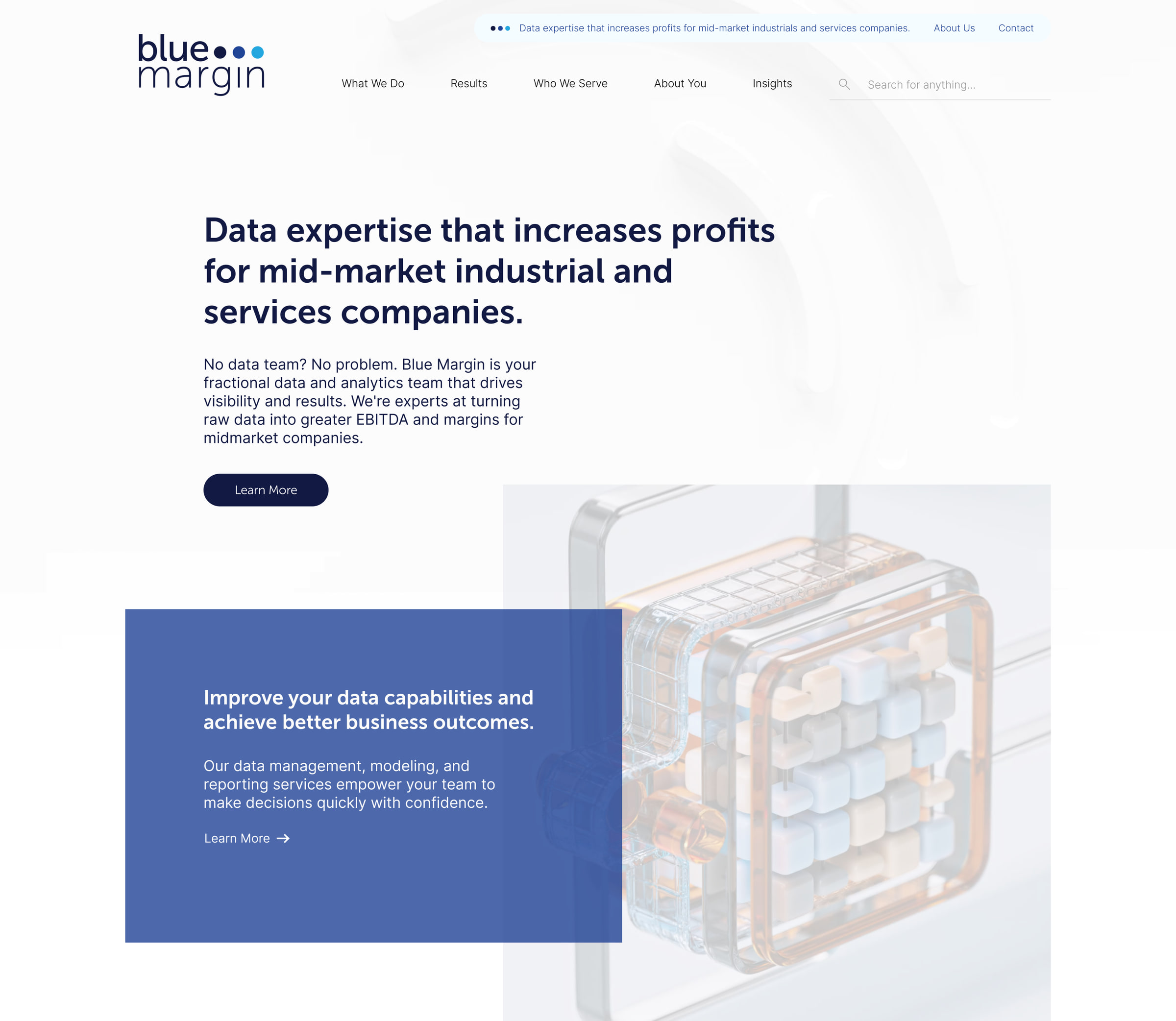
Blue Margin is a fractional data and analytics team that turns raw data into EBITDA for mid-market companies. I designed its product: one system that makes a complex, high-trust consultancy legible and low-risk, sold like a product, carried straight from the brand I had built.
- Role
- Senior Product Designer
- Timeline
- 2023 to 2024
- Outcome
- Brand to a build-ready product system, three audiences, one architecture
Context
Blue Margin is a fractional data and analytics team for mid-market industrial and services companies. It does the job of an in-house data department, turning raw data into dashboards, models and decisions that move EBITDA and margins, for companies that have no data team and no appetite to build one. It often sells to private-equity-backed operators under pressure to professionalize fast. I had built the Blue Margin brand. The next job was to make it a product: the site that sells it.
Problem
A consultancy is one of the hardest things to sell online. The deliverable is judgement, the price is usually a negotiation, and the buyer has been promised “data-driven” by everyone. Blue Margin needed a site that did three hard things at once: make an abstract service concrete, make a high-trust purchase feel low-risk, and speak to operators, private-equity sponsors and future hires without building three separate websites.
The brand already existed and was calm and credible. What did not exist was the product surface: the architecture, the page system, the proof. Copy and the front-end build sat with the Blue Margin team, which made the design problem sharper, not softer. The system had to be unambiguous enough to hand off and stay coherent once it left my hands.
Approach
A consultancy, sold like a product
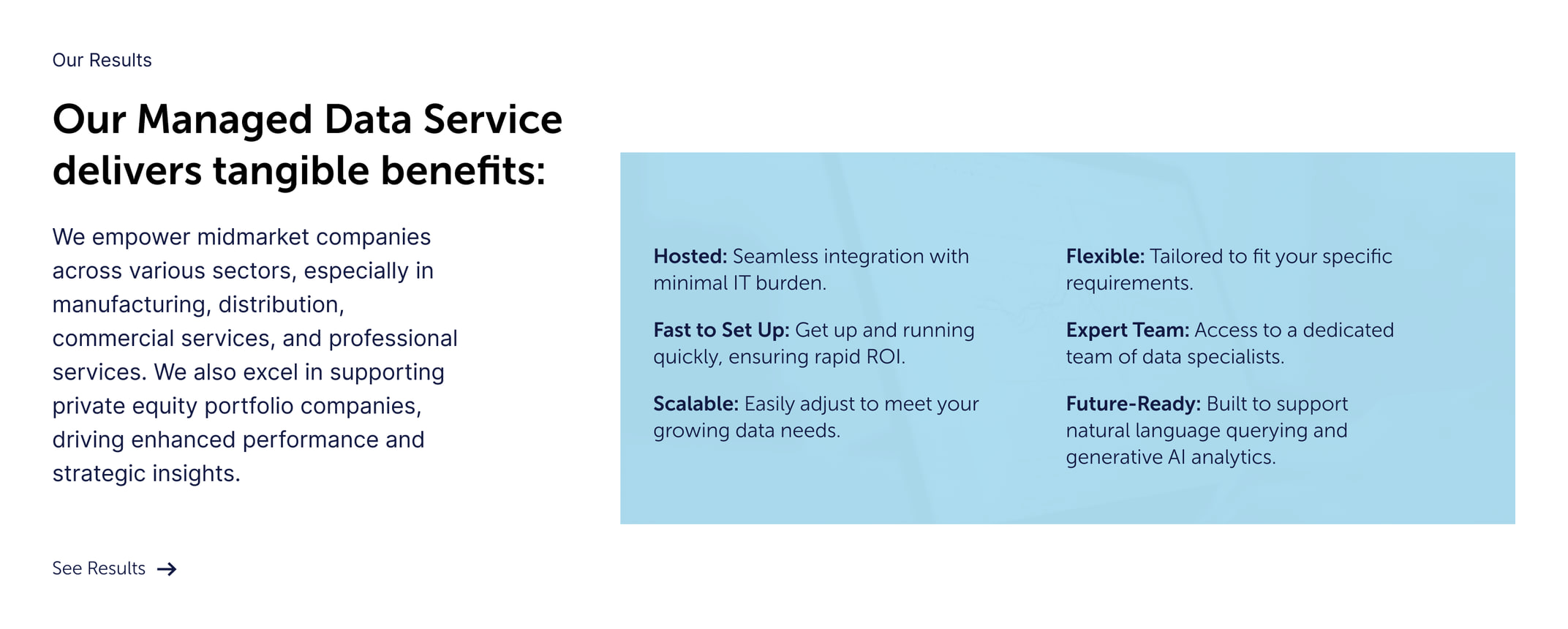
The core move is to stop selling consulting. Every surface leads with the outcome an operator wants, profit and margin, and names the work as a service with a shape: the Managed Data Service. The offering pages do the un-abstracting, turning “data architecture” into a defined engagement with a partner badge and a clear set of benefits.

Every positioning decision had to become a defensible product decision, not a mood. I treated the brand’s position as the specification.
A consultancy, made legible as a product
Every product decision traces back to the positioning, not to taste
- Lead with the outcome, not the discipline Every surface opens on profit, EBITDA and margin, not on data engineering. The work is named the Managed Data Service, not consulting.
- Price like a product, not a project A flat, public subscription and a stated MDS Promise replace the opaque scoping that makes mid-market buyers hesitate.
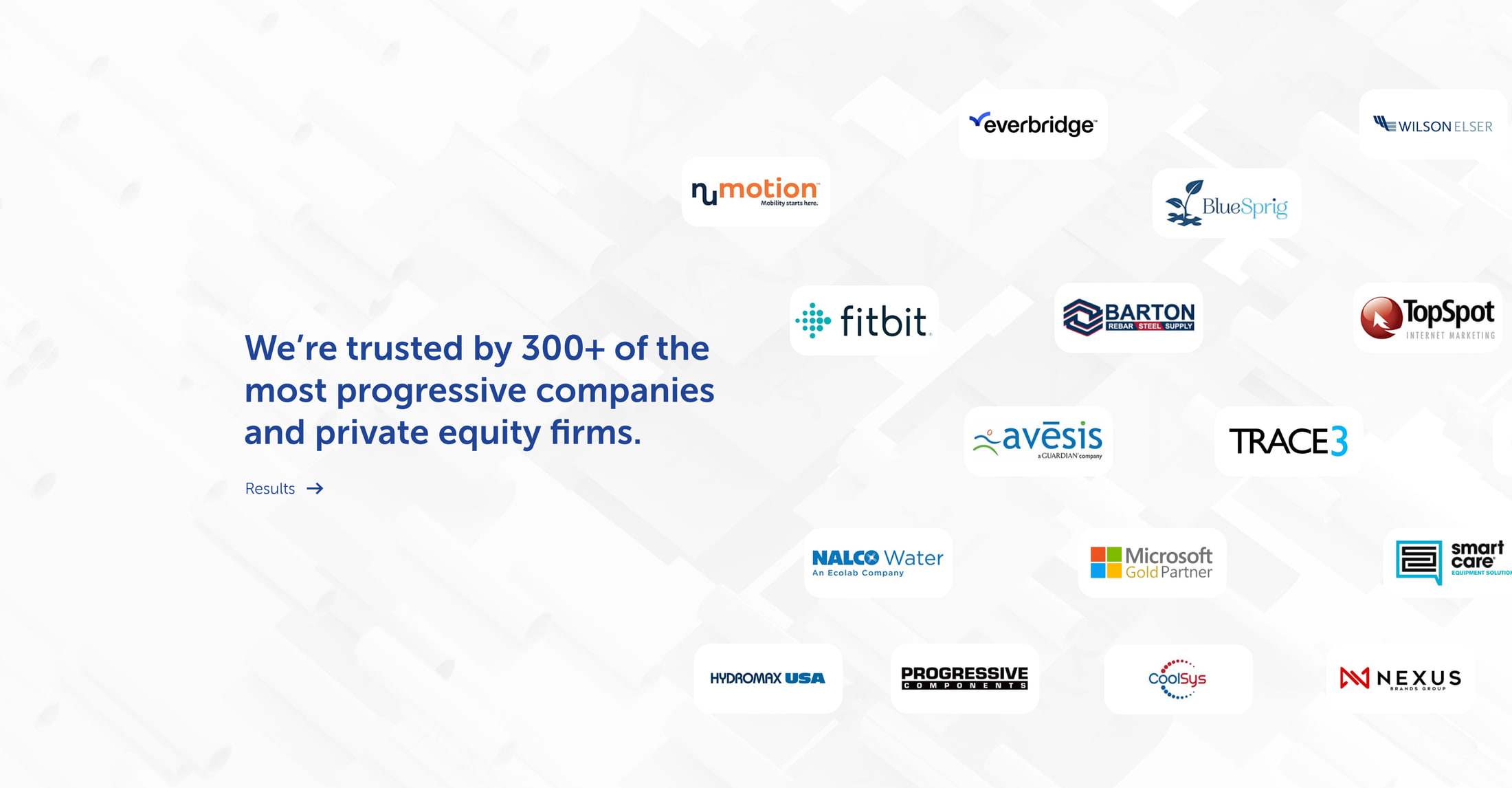
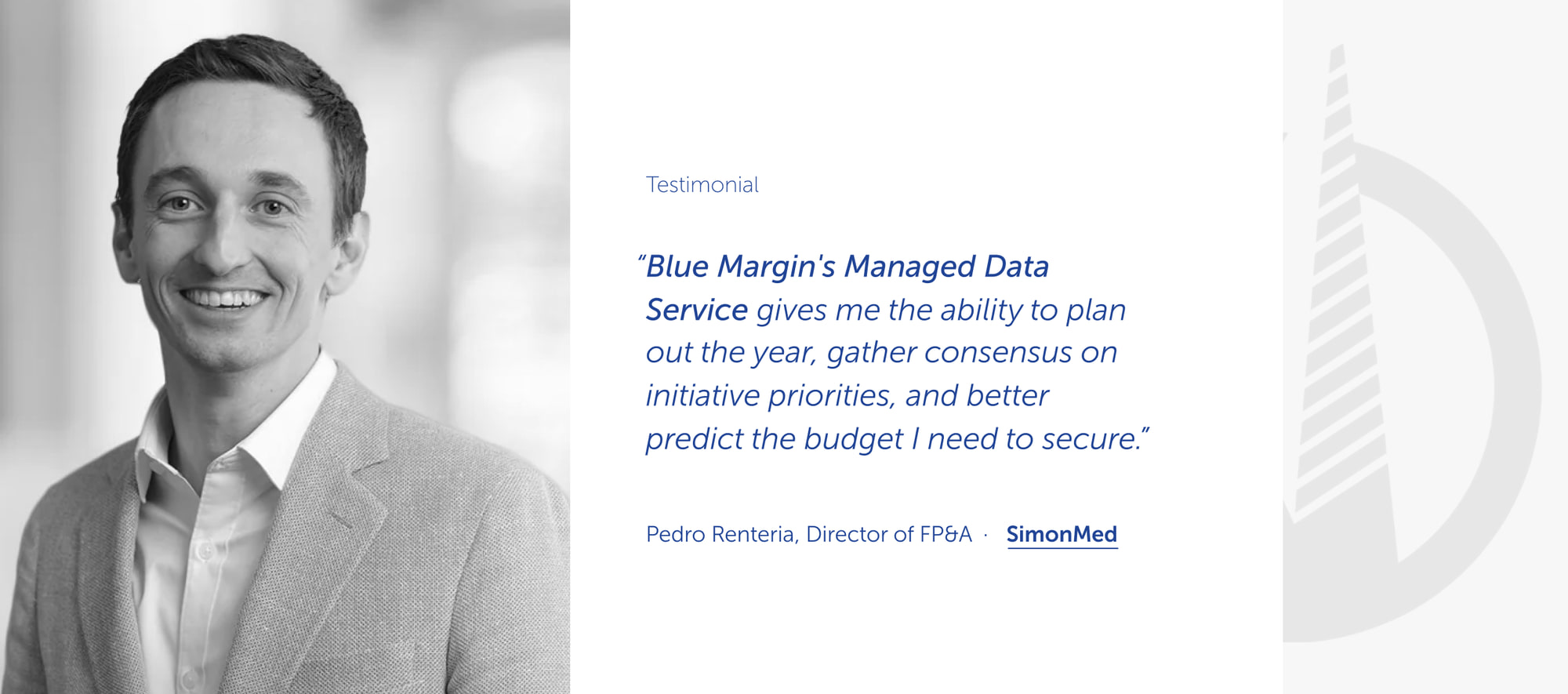
- Proof carried as a system, not a claim A 300-plus logo wall, operators named by title and firm, and real case studies do the convincing the category's jargon cannot.
- Own the category's media The Dashboard Effect podcast and book make Blue Margin the source midmarket and private-equity leaders learn from, not just a vendor.
- One system, many audiences Operators, private-equity sponsors and recruits each meet their own argument on one architecture, never a diluted pitch.
Proof as a system, not a claim
A skeptical operator does not believe adjectives, so the site argues with structure. A wall of more than three hundred client and private-equity logos sets the floor. Operators are named, by title and firm, not anonymized. And the service states its benefits as plain mechanics, not promises.
One architecture for three audiences
Diluting the message to serve everyone would have lost everyone. Instead the architecture forks, an operator, a private-equity sponsor and a recruit each get their own argument, then all converge on the same qualifying funnel, so the site sells and pre-screens in one motion.
One architecture, three audiences, one funnel
Operators
Can this turn our raw data into EBITDA without us building a data team?
Private-equity sponsors
Can a portfolio company become data-driven fast, and stay there?
Recruits
Is this a team of experts I actually want to grow with?
All three converge on the same qualifying funnel
- 01 Tell us what you need Every page lands on one prompt, What can Blue Margin do for you, so intent is captured before a pitch.
- 02 A fractional team is scoped Not a project quote: a named, dedicated data team mapped to the operator's gaps.
- 03 The Managed Data Service runs A flat monthly subscription with the MDS Promise, so the decision is on specifics, not a sales bet.
The homepage, end to end
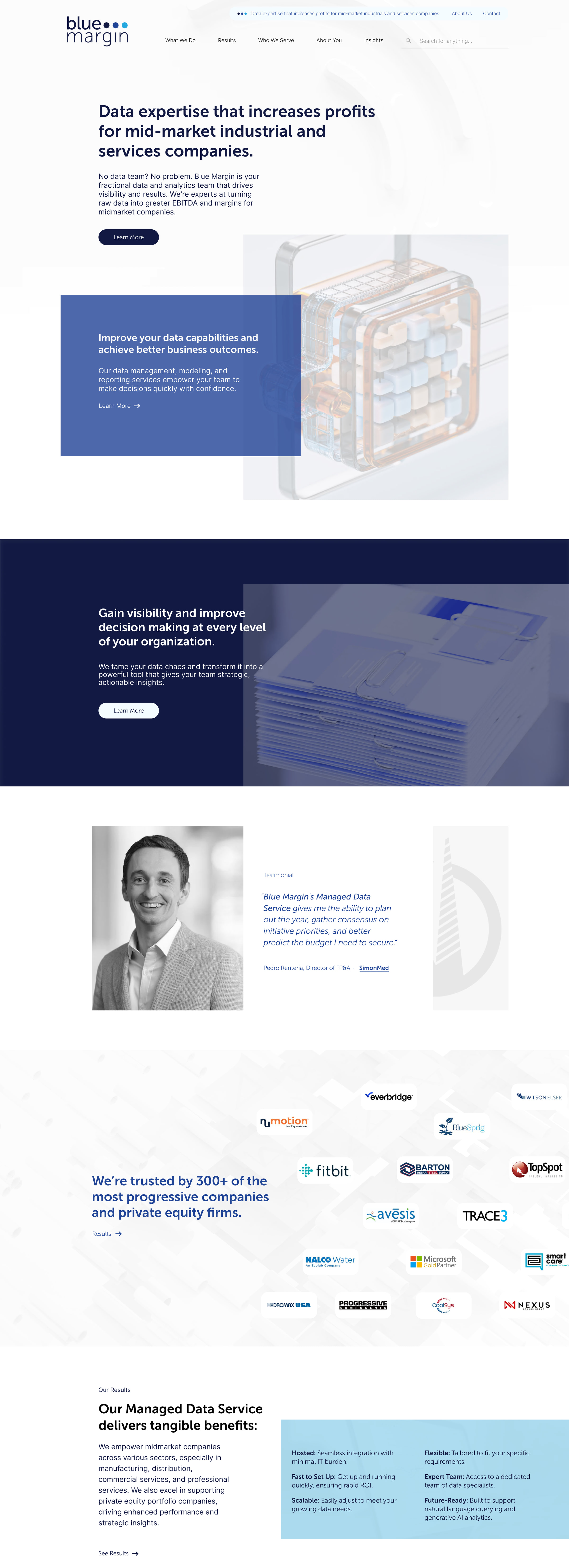
A system only proves itself as a whole page. The Blue Margin homepage is one library from the navigation down: the outcome-led hero, the visibility argument, a named operator, the three-hundred-plus proof wall, and the productized service. Because the page carries real video and the buttons answer with their own micro-interactions, this is the live prototype, not a flat capture.
Outcome
Delivered as a build-ready product system: the positioning-to-interface strategy, the multi-audience information architecture, the full page set, and the design system that carries the Blue Margin identity into the product unchanged. It was handed to the Blue Margin team to build, and it was specified to stay coherent once it was.
- 300+
- Companies and PE firms the proof wall carries
- 1
- Consultancy, sold as one productized service
- 0
- Brand drift from the identity to the product
The identity this product grew from, the mark, type and brand system, lives in the visual archive.
Reflection
The discipline here was refusing to sell like a consultancy. Consulting sites hedge, every claim wants a qualifier, every price wants a conversation. Blue Margin only worked because the brand had already decided that confidence, stated plainly, was the strategy, so productizing the offer was the brief, not my preference. The three-audience fork was the call I was least sure of and now most sure about: it looked like triple the site to maintain, and on one system it was nearly free, and it is the only honest way to talk to an operator, a sponsor and a future hire at once. If I did it again I would design the proof system before the pages, not alongside them, because on a site selling judgement, the proof is the product and it deserves to exist first.
Product design, information architecture and the brand-to-product system: mine, end to end. Copy and front-end build: the Blue Margin team.